
10 Must-Have Features for Your Creator Management Platform
- Sanket Maheshwari
- 10 hours ago
- 9 min read

An agency account director is onboarding a new brand client. The brief is ready. The creator shortlist is approved. This is where the real work starts.
She needs to send the brief to 18 creators, track who has confirmed receipt, manage script revisions without feedback scattered across three channels, check which creators have gone live without waiting for screenshots, and have a client report ready the week the campaign ends.
Her current platform handles discovery well. Everything after that runs through WhatsApp, email, and a spreadsheet that two people are editing simultaneously.
She didn't buy a creator management platform. She bought a creator search engine.
What actually separates a platform from a search engine
Database size isn't the benchmark. The benchmark is whether a platform covers the whole creator relationship, from the first search through tracking performance across multiple campaigns.
If a platform only helps you find creators, it's really just a discovery tool with a different name. A complete influencer marketing platform should also help with onboarding, sharing briefs, approving content, tracking deliverables, monitoring live posts, managing creator relationships, and reporting performance across platforms.
The ten features below cover all of these areas and solve the problems teams usually face when they're missing.
Feature 1: Natural language search instead of filter boxes
A filter-based database forces the team to translate the brief into parameters. Niche, follower range, location, engagement rate. Every translation is a guess, and a creator matching all four boxes can still have an audience that's 60% outside the target market.
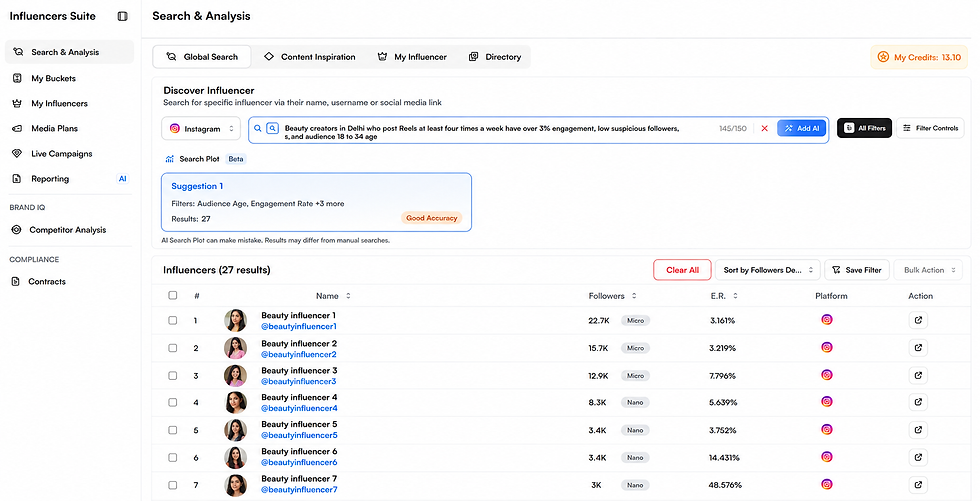
A good search tool should be able to understand a simple campaign brief. For example, if you type "beauty creators in delhi, who post reels at least four times a week,have over 3% engagement rate,low suspicious followers,and have women audience between age 18 to 34 years" it should show the most relevant creators right away, without making someone go through a filtered list manually.
CultureX's "Search influencer or ask AI" processes queries like that against 400M+ creator profiles, with credibility data including real follower percentage and suspicious account rate showing up in the initial result before anyone shortlists anything.
If a platform can't take a brief written in plain language, it's a search engine, not a creator management platform.
Feature 2: Audience quality data right at discovery
Most platforms make audience quality a separate report request. By the time that report arrives, the creator's already been recommended to the client. Discovering a fake follower problem after the campaign runs is an expensive way to run this check.
The search results should show audience quality at a glance, without making users open a separate audit report. This should include:
Real People: Genuine users who follow and engage with the creator because they enjoy the content.
Mass Followers: Real accounts that follow more than 1500 profiles, making it less likely they'll regularly see or interact with every post.
Suspicious Accounts: Profiles that appear fake, inactive, automated, or created for spam, adding little to no real value.
If this information only appears after a shortlist is created, it's often skipped or discovered too late to influence the selection process.
Feature 3: Overlap analysis across the whole creator pool
Five micro-creators with 80,000 followers each don't add up to 400,000 unique people if their audiences overlap. Without checking that, the reach figure going into the client recommendation is almost certainly inflated.
This needs to run automatically across the full shortlisted pool, before the brief goes out, not as a correction after the campaign ends. CultureX's overlap tool calculates
actual unique reach across the selected creators before any shortlist gets finalised.

Feature 4: A creator community that the agency actually owns
A creator database that resets when the subscription lapses is a rental. An agency rebuilding its roster from scratch for every campaign is paying for the same work repeatedly.
What really works is a branded creator community that you own inside the platform, rather than using a ready-made database. The onboarding process should occur within the platform itself, collecting details such as email, age, gender, platform, content category, and social handles. Once creators sign up via a bio link or social group, their information should automatically appear in a live dashboard, making it easy to filter and manage creators based on the details collected during signup.
CultureX's Community Suite builds exactly this, a branded creator community with native onboarding and a live dashboard, turning what used to be a one-time campaign list into something the agency can keep using.
Feature 5: Track Every Brief from Send to Read
A brief sent over WhatsApp or as an email attachment has no version history and no way to confirm whether the creator received it. When content comes back off-brief, there's no way to tell whether the creator ignored the brief or never had the right version in the first place.
Brief delivery needs to happen inside the platform itself, with version history and read confirmation, so the agency can see exactly when a creator opened it and which version they got.
Feature 6: Feedback that lands in one place
Content goes out for review. One person replies by email, another in Slack, a third leaves a WhatsApp voice note. The account manager has to consolidate all three by hand and send the creator notes that may or may not reflect what everyone actually meant. The creator revises. The same thing happens again in the next round.
The easiest way to avoid confusion is to collect everyone's feedback in a single thread before sending it to the creator. Creators can submit scripts and drafts through their dashboard; every approval or rejection is timestamped, and scripts are automatically converted into a version that's easy to review.
CultureX's Operator Board centralises all of this. Reviewers comment in a single thread, revision rounds are logged with timestamps, and the creator receives a single consolidated set of notes rather than three conflicting ones.

Feature 7: A pipeline that shows every creator's status at once
A campaign with 15 creators and staggered go-live dates can't be reliably tracked in a spreadsheet. Deadlines slip because whatever's tracking them isn't connected to the content itself.
It helps to have a clear pipeline where every creator moves through stages like Onboarding, Scripts in Approval, Scripts Approved, Videos in Approval, Approved, and Live. That way, you can see everyone's status on a single screen, without opening each profile or chat to check what's happening. If an agency manages a large creator community, the platform should also be white-labelled so clients see only the agency's branding.
CultureX's Operator Board maps every stage in a single pipeline view, and it can be white-labelled for agencies that want a fully branded client experience.
Feature 8: Live tracking without chasing screenshots
When live tracking depends on manually checking profiles or waiting for screenshots, the account manager is always the last to know what's gone live. A client who follows the creator sees the post before the agency does.
What's needed is hashtag and live link tracking that pulls in content automatically as creators post, with engagement data attached from the first hour. No profile checks, no screenshot requests.
CultureX pulls live content automatically using campaign hashtags and creator handles, and it shows up in the reporting dashboard the moment it's live.
Feature 9: Per-creator analytics across platforms
After a campaign ends, many teams still have to pull data from different dashboards and paste everything into a spreadsheet just to build a report. By the time it's finished, the campaign is already old news. It's also difficult to understand how each creator performed or what kind of audience response the campaign received while it was live.
What really matters is having all your campaign data in a single report, rather than downloading separate reports for Instagram, YouTube, TikTok, and other platforms. The numbers should refresh daily for up to 90 days after the campaign ends, including creator-level metrics such as CPE, CPV, ER, and sentiment. Each post should also be automatically tagged as positive, neutral, or negative using NLP, and the final report should be easy to share through a secure link that doesn't require anyone to log in.
CultureX's reporting module generates exactly this, updated daily for 90 days, with sentiment scored automatically.

Feature 10: Knowing what competitors' creators are doing
An agency recommending a creator who's mid-campaign for a direct competitor is recommending a conflict. Without competitive intelligence built in, the client finds that out before the agency does.
This needs to cover brand-to-brand comparisons, showing competitor activity, content volume, unique creator count, and total views. It needs real-time visibility into which creators competitors are working with right now, not a snapshot from last month. A filter to separate paid collaborations from organic mentions shows what competitors are actually spending on versus what's happening naturally, and sentiment on competitor content shows how audiences are responding before budget gets committed.
CultureX's Competitor Analysis module consolidates all of this into a single dashboard.

The scoring checklist
Run this before any platform demo.
Feature | Question to ask |
Natural language search | Does it accept brief language, not just filter boxes? |
Audience quality at discovery | Real people percentage, suspicious rate, geography in the result? |
Overlap analysis | Actual unique reach calculated before the brief goes out? |
Brand-owned community | Named community with native onboarding and live tracking? |
Brief delivery with confirmation | Brief opens inside the platform, with version history visible? |
Centralised approval | All feedback in one place before reaching the creator? |
Pipeline tracking | One view showing every creator's status, onboarding through live? |
Live content tracking | Auto-fetches content on posting, no screenshots? |
Cross-platform analytics | Unified, daily-updated report, per-creator CPE/sentiment/ER? |
Competitive intelligence | Visibility into which creators competitors are using now? |
Want to see how CultureX scores on every criterion above? Book a walkthrough, and we'll run through each one live.
Eight signs the current platform is covering half the job
The team found great creators on the platform and ran the entire campaign via WhatsApp and email.
Audience quality checks happen after the brief goes out, not before the shortlist gets finalised.
The client report takes more than 2 days to compile and is already stale by the time it's delivered.
Feedback on creator content passes through three channels before reaching the creator.
There's no visibility into which creators competitors are actively working with
A 15-creator campaign's deliverable-tracking spreadsheet lives in a document that two people are editing independently.
A creator gets briefed and paid before anyone checks whether their past content carries sensitive, controversial, or off-brand material that could put the campaign at risk.
The budget gets allocated to a creator without any estimate of what the campaign will actually cost per engagement, so the first real number the team sees is the invoice.
The platforms that earn a permanent spot in an agency's stack aren't the ones with the largest databases. They're the ones that stay useful from the first brief through the last debrief.
Discovery is roughly 20% of the work. This checklist is for the other 80%.
CultureX’s features, like AI-powered influencer discovery, reporting, content safety analysis, estimate cost feature, campaign management, and competitor analysis, help do the job properly rather than covering only half the job.
Ready to see a creator management platform that covers all ten features? Start your free trial on CultureX.
FAQs
What is a creator management platform?
A platform covering the entire creator relationship, not just finding creators. Discovery, onboarding, brief delivery, content approval, deliverable tracking, live monitoring, and reporting, all in one place. The distinction from a discovery tool becomes apparent the moment a campaign goes live, and the workflow either continues within the platform or falls back to WhatsApp.
What features should a creator management platform have in 2026?
A good creator management platform should do much more than store creator data. It should let you search creators using natural language, show audience quality while you're discovering creators, check audience overlap, manage a brand-owned creator community, send briefs with read receipts, handle content approvals, track campaign progress, monitor live posts without screenshots, provide creator analytics across platforms, and show which brands creators are already working with.
How is a creator management platform different from an influencer discovery tool?
Finding creators is only one part of the job. Discovery tools help you search for creators, while a creator management platform helps you manage everything that comes next, like onboarding, sending briefs, approving content, tracking live posts, and reporting campaign results. Some platforms even show audience quality before you shortlist creators.
Can a creator management platform handle multiple client accounts for agencies?
Yes, if it's designed for agencies. Features such as a branded creator community, separate workflows for different clients, and white-labelled reports make it much easier to manage multiple accounts from a single platform.
How does a creator management platform help with fake follower detection?
It shows audience quality metrics like real users, suspicious accounts, and audience location before you shortlist creators. Since creators with similar follower counts can have very different audience quality, seeing this data early helps avoid poor choices.
What is a creator CRM, and do I need one?
A creator CRM helps you keep track of every creator you've worked with, their past collaborations, and how they performed. Instead of creating a new roster for every campaign, you build a creator network that you can keep using and improving over time.
How do creator management platforms handle content approval and deliverable tracking?
Most platforms keep everything in one workflow. Feedback is shared in a single place, creators upload content through their dashboard, and approvals are tracked with timestamps. You can also see the status of every creator, from onboarding to live content, without switching between multiple tools.
How does CultureX work as a creator management platform for agencies and brands?
"Search influencer or ask AI" handles discovery across 400M+ profiles with credibility data built into every result. The Community Suite manages onboarding and creates a branded, owned creator community. The Operator Board runs the full campaign pipeline, white-labeled where needed. The reporting module covers cross-platform analytics with NLP sentiment scoring, updated daily for 90 days. And the Competitor Analysis module shows what competitors' creators are doing in real time.


Comments