
How to Hire Influencers: A Practical Guide for Brands
- Sanket Maheshwari
- 13 hours ago
- 11 min read

The influencer marketing campaign wrapped three weeks ago. A few posts performed well.
But ask your teams which influencer drove the most conversions, or if you can rebook the same influencer for the next campaign, and the answer will be a rough estimate.
This is what influencer hiring looks like without a clear process. It doesn’t necessarily mean you failed at a campaign. It just means you ran an incomplete one where the information needed to make the next campaign better was simply not collected.
A structured influencer hiring process changes what the brand knows at every stage.
This includes knowing what a strong candidate looks like before the search begins.
Or whether a shortlisted creator's audience actually fits before any budget is committed.
What the creator is expected to deliver before they post. And whether they delivered it after the campaign ended.
The six steps below cover the full process in sequence.
Step 1: Define what the campaign needs before searching for anyone
Surface-level research can only give you surface-level answers. This step ensures your planning stage is foolproof. The brief is “we need influencers for a product launch,” and the search begins the same day. The result? You do get a shortlist, but there is no clear rationale for why a particular creator was chosen.
Three things need to be defined and agreed internally before any search begins.
Setting the campaign objective
Start with a clear objective before anything else. Do you want to improve brand awareness, or is it more focused on conversions? This will lay the foundation for the metrics you should evaluate, the brief you’ll prepare, and the influencer you'll target.
For example, take a skincare brand launching a new serum. If they’re targeting wider reach and awareness, they’d probably opt for macro creators with large followings, even if their engagement rates are moderate. Whereas, if the objective is conversion, they’d opt for micro-influencers with a highly engaged, purchase-ready audience in the right demographic with a limited following. Same product, same budget, completely different hiring standards depending on what the campaign is actually trying to achieve.
Building the target audience profile
The audience profile is not a description of the influencer you’re planning to onboard. It is a description of the influencer’s audience. Define the age range, gender split, geographic markets, and category-specific characteristics. A creator based in Mumbai can have the majority of their following in markets the brand does not serve. Audience location data matters more than creator location.
Establishing non-negotiables before the search begins
These are the bare minimum criteria that determine who qualifies before additional hiring rules are applied. You define the platform, minimum engagement rate, category relevance, and posting frequency. Without these defined upfront, the search produces either too many irrelevant results or a shortlist that looks right but isn't.
Step 2: Search and shortlist using credibility data, not follower count
It’s easy to run after the follower count. More followers mean more reach, right?
But no, while it is the most visible metric in creator discovery, it is the least useful for predicting campaign performance.
Two creators with the same follower count in the same niche can have completely different audience quality. One creator can have 74% real, engaged followers, concentrated in the right geography. The second one has 51% real followers with a significant share of inactive accounts in the wrong markets. The difference does not show up on a profile visit. It shows up in campaign results.
Five checks to run before shortlisting any creator
Niche relevance
Check if the creator’s last twenty to thirty posts show consistent concentration in the relevant category. Not occasional posts between broader lifestyle content.
Real follower percentage
There are a bunch of ‘influencers’ out there with a lot of fake followers. Check if the proportion is genuine. For that, you’d need to run an influencer authenticity check. This is what separates a credibility-based shortlist from one built on appearances.
Suspicious account rate
Check if the account has a large number of bots, spam, and inactive accounts. This inflates engagement rate calculations without delivering real audience reach.
Audience profile
Instead of relying on the influencer's profile or bio, check the location, age split, and gender breakdown from actual audience data.
Content Safety Analysis
Does the creator have any past posts that are flagged for sensitive keywords, competitor brand mentions, or content that carries brand risk? You cannot afford to skip this as it is the most expensive to discover after a brief has gone out.
CultureX's Influenzer.ai surfaces all five data points per creator directly in the search result, before any shortlisting decision is made.
How to combine influencer discovery and vetting into one step
Usually, discovery and qualification happened separately. You search influencers manually, build a list, then check each profile individually to see if they’re credible. For twenty creators, that process takes hours. For a hundred, you don’t even want to know.
Tools to find influencers that combine search and credibility data in one result change this significantly.
CultureX's Influenzer.ai accepts a full campaign brief in natural language and returns ranked creator matches from 400M+ profiles with all five credibility checks already attached. Finding the right influencer for your brand and vetting them happens in one step rather than two.
Find credibility-checked influencers whose audience actually matches your target buyer
Step 3: Contact at scale without losing personalization
Most brands send influencer outreach in two ways. Either they send fully personalized messages to each creator, or they use a generic template copied for everyone. Neither is scalable. The first method is time-consuming, and the second reads like a mass message, greatly reducing reply rates. The answer to this? Take the middle way out.
What the first message should and should not contain
Template outreach with specific personalization fields supports higher reply rates. Add the creator's name, one reference to a recent piece of content, platform, and campaign category. Everything else stays standard across all outreach. These personalization fields are what change the reply rates. The product description, campaign type, and ask do not need to vary per creator.
Two things that should never be in the first message:
A full campaign proposal
Any mention of usage rights, exclusivity, or go-live dates.
The first message asks one small question. Are they open to collaboration? Is this category relevant to them? Would they like to see the brief? That is the entire ask.
The follow-up sequence that actually gets replies
You can hardly expect an influencer to reply in the first message. The second or third contact is where you can expect some replies. A follow-up at days five to seven and a final follow-up at days twelve to fourteen reach creators who are interested but slow to respond without damaging sender credibility.
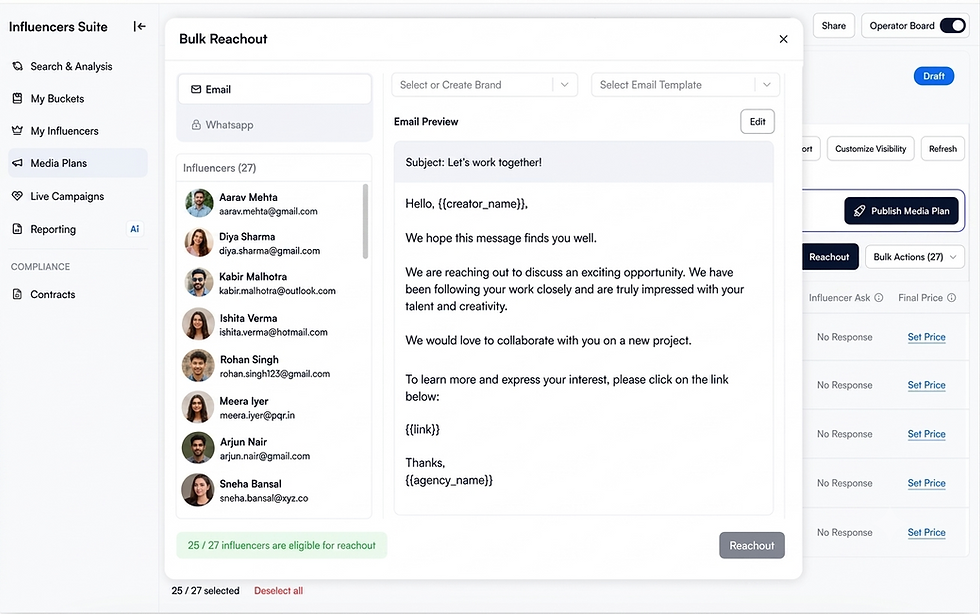
CultureX's Media Plans module handles bulk outreach with custom templates, dynamic personalization fields per creator, integrated response forms where creators submit pricing and availability in an organized format, and open and reply rate tracking per outreach batch.
Step 4: Brief properly before any content is produced
Here, the motive isn’t just to produce a good content brief, but a compliant one. A compliant brief means that the creator followed the instructions. Good content means the creator integrated the brand naturally into their existing voice.
What should a proper influencer brief contain?
One specific direction
This doesn’t just include the feature list but also a context statement. It tells the influencer where the product fits in their actual life, what situation it is for, and what feeling the content should produce. Something they can translate into their own voice rather than a script they have to perform.
Clear non-negotiables
Mention where the product needs to be visible. It can be in the content, a tracked link in bio or Stories, or a specific CTA. These are the requirements that must be met. Everything outside them is the creator's creative territory.
Usage rights
Determine the usage rights upfront. Don’t wait to negotiate after the content is already live. If the brand wants to repurpose content as paid creative, that must be included in the brief and confirmed in the contract prior.
Unique tracking per creator
Does the campaign need to have a discount code or a UTM-tagged link pointing to the specific product page? This goes in the brief as a non-negotiable, not as an add-on.
Brief delivery as a workflow tool, not simply a message
Most brands send the brief through channels like WhatsApp or email. What happens here is you don’t get any version control, real confirmation, or record of what was agreed upon.
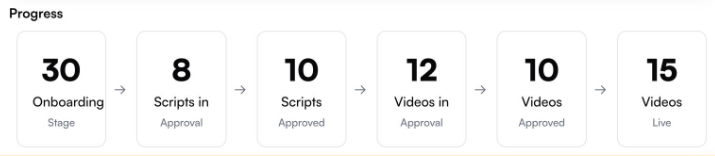
CultureX's Operator Board delivers briefs inside the platform with version history and read confirmation, so when a creator claims they did not receive the brief, the platform shows exactly what was sent and when it was opened.
Step 5: Handle the contract before work starts
A contract clause cannot change the content that is already live. Any additions after are simply paperwork and do not add to compliance. The contract needs to be a prerequisite, not a formality.
What every influencer contract must address
Deliverables and timeline
Define the number of posts, platforms, formats, and dates it will go live. It must be agreed to and signed before the creator receives the product or payment.
Usage rights
Determine the paid amplification, whitelisting, use in email campaigns, and length of rights period. Specify each detail beforehand, rather than revisiting after the content performs.
Disclosure requirements
The influencer should clearly and correctly disclose the paid partnership on each campaign post. The language should be written into the contract, and not left to the creator’s interpretation.
Revision process
Define how many rounds of feedback are included and what happens if the content does not meet brand requirements after the agreed revision rounds are exhausted.
Enforcing signing as a prerequisite to campaign access
The most common contract problem is not what it contains. It is that it gets signed after work has already started.
CultureX's Contracts module creates dynamic contracts with campaign variables auto-populated from platform data, supports e-signature directly inside the platform, and enforces signing before a creator can access the campaign dashboard. A creator who has not signed cannot proceed.

Step 6: Track performance per creator, not just campaign totals
This is the step where you need to gauge reporting at the individual level rather than at the campaign level. Brands usually pull the report two weeks after the campaign ends, showing campaign totals rather than per-creator breakdowns. It becomes impossible to identify which creator drove the most conversions and which underperformed. A campaign total is not actionable. Per-creator data is.
The four metrics that matter per creator
CPE and CPV per creator
Have individual figures instead of a campaign average for Cost per Engagement (CPE) and Cost per View (CPV). This helps identify underperformers and overperformers, making future influencer hiring decisions easier.
Attributed conversions per creator
This measurement is possible only when unique discount codes and tracked links are built into the brief at Step 4 as discussed. This is the ROI figure that helps you determine future campaigns.
Influencer authenticity check post-campaign
Measure this to know whether the engagement the creator's content received was genuine. High reach with suspiciously low interaction levels warrants a closer look before rebooking.
NLP sentiment per creator
This metric shows whether the audience responded positively, neutrally, or negatively to each creator's content. A high-reach post with negative sentiment is a brand risk.
Why the 90-day window changes what the report tells you
Influencer content, such as product reviews and tutorials, continues to drive engagement and conversions for weeks after going live. A report pulled on the fourteenth day misses a significant share of the actual return on the campaign spend.
CultureX's reporting dashboard tracks all four metrics per creator, updated daily for up to 90 days post-campaign. Reports are shareable via a secure link with no login required, so the performance view the client or leadership sees is the same live data the internal team is working from.
The influencer hiring checklist
Use this before every campaign. Each line is an action with a clear yes-or-no answer.
Before searching
Campaign objective, target audience profile, and non-negotiables are defined in writing before any search begins.
During discovery and shortlisting
Real follower percentage, suspicious account rate, audience profile, and Content Safety Analysis are checked per creator before anyone is shortlisted. Influencer authenticity check completed before any commitment is made.
During outreach
Outreach sent with one specific personalization per creator, one small ask, no campaign proposal in the first message. Follow-up is planned on days five to seven and days twelve to fourteen.
Before briefing
Non-negotiables listed. Usage rights specified. Unique tracking code or UTM link per creator included as a mandatory brief element.
Before any work starts
Contract signed on the platform before the creator receives the product, brief access, or the first payment.
After the campaign
CPE, CPV, attributed conversions, and NLP sentiment were reviewed per creator across a full 90-day window.
Conclusion
Influencer hiring without a process produces campaigns that can be evaluated and improved. Every step that you skip compounds the one before it. A creator brief hired without an audience check produces content built for the wrong audience. A campaign measured at two weeks instead of ninety produces a report that cannot answer whether the hire was worth repeating.
The process is what makes each campaign produce information that improves the next one. Brands that treat influencer hiring as a structured, repeatable process do not just get better results. They get better at getting better results.
Ready to run the full influencer hiring process from discovery to post-campaign reporting in one platform?
FAQS
How do I hire influencers for my brand?
You should start by defining the campaign objective, target audience profile, and non-negotiables before opening any search. From there, the process runs in sequence: discovery and credibility qualification, outreach, briefing, contracts, and post-campaign tracking per creator. Influencer hiring without that sequence produces inconsistent results because each stage depends on the one before it.
What should I look for when hiring influencers?
Look beyond follower count. The metrics that actually predict campaign performance are real follower percentage, suspicious account rate, audience demographics, and content safety signals. Finding the right influencer for your brand means verifying that the creator's audience matches the target buyer, not just that the creator's profile looks relevant.
What tools are used to find influencers?
Tools to find influencers range from basic search directories to platforms that combine discovery with audience credibility data in one result. The most useful ones surface real follower percentage, audience demographics, and content safety signals per creator before any shortlisting decision is made. CultureX's Influenzer.ai searches 400M+ profiles with all credibility data already attached to each result.
How do I check if an influencer is authentic before hiring them?
An influencer authenticity check should cover four things. This includes the real follower percentage, suspicious account rate, audience demographics pulled from actual audience data rather than inferred from the creator's profile, and a content safety scan of past posts flagged for sensitive keywords or competitor mentions. Check all four before shortlisting, not after.
How much does it cost to hire influencers?
The cost to hire influencers varies significantly by tier, platform, and category. Nano and micro-influencers typically charge less per post but often deliver stronger engagement rates and have a more concentrated audience. On the other hand, macro and celebrity creators carry higher fees and broader reach. The more useful cost metrics are CPE and CPV per creator after the campaign.
What should an influencer contract include?
Every influencer contract should specify deliverables and go-live dates, usage rights including paid amplification and whitelisting, disclosure requirements with the exact required language, and the revision process. The contract should be signed before the creator receives the brief, product, or first payment.
How do I measure the results of hiring influencers?
You should measure per creator, not just campaign totals. The four metrics that matter are CPE, CPV, attributed conversions tracked via unique discount codes or UTM links, and NLP sentiment per creator. You should pull the report over a 90-day window, not two weeks, because influencer content continues to generate engagement and conversions well after the go-live date.
How does CultureX support the full influencer hiring process?
CultureX covers every stage of influencer hiring in one platform. Influenzer.ai handles discovery and credibility vetting across 400M+ profiles. Media Plans manages bulk outreach with personalization and response tracking. The Contracts module enforces e-signing before campaign access. The Operator Board manages briefs and content approvals. And the reporting dashboard tracks CPE, CPV, and NLP sentiment per creator for up to 90 days post-campaign.


Comments