
What Is Community Management and How AI Makes It Scalable for Brands
- Sanket Maheshwari
- Jun 20
- 8 min read

Updated: Jun 22
It's Monday morning. A brand manager logs into Instagram and sees 847 comments on the weekend post.
Forty of them are about a customer service issue that started Friday night. Twelve are asking about product availability. Six are from potential retail partners. Three are from creators wanting a collaboration.
Her process is to scroll through all 847 and manually respond to the ones that seem important.
By Wednesday, she has gotten through about 200. The service issue from Friday now has 34 replies. The creator who asked about a collaboration on Saturday has already posted with a competitor.
That is not a community management failure. That is a scale problem. And scale problems have solutions.
What community management actually is
Most brands think of community management as replying to comments. It is a lot more than that.
Community management is the process of building and maintaining meaningful relationships between a brand and its audience across social media. It goes beyond replying to comments and messages by helping brands monitor conversations, understand audience sentiment, moderate discussions, and encourage ongoing engagement. The goal is to create an active community where people feel heard and connected to the brand.
Where it breaks down when brands grow
Managing a small community is fairly straightforward, but things get more complicated as the audience grows. More followers mean more comments, mentions, and conversations happening across different platforms, making it difficult for small teams to keep up.
Too much to monitor: As campaigns scale, thousands of interactions can happen every month. Reading every comment or reply manually is no longer practical, so many valuable conversations get missed.
Slow responses to important issues: Negative feedback or customer questions can spread quickly. If teams rely on manual checks, they may notice the problem only after the conversation has gained momentum, making it harder to respond effectively.
Hard to identify what matters: Looking at individual comments doesn't reveal the full picture. The real value lies in spotting recurring themes like product feedback, purchase intent, or service issues. Without the right tools to organise and classify conversations, these patterns are easy to miss.
How AI makes each function manageable
Comment classification replaces manual reading.
The most time-consuming part of community management is reading comments to determine what they mean and how to respond. AI comment classification handles this step automatically.
CultureX's Track.social uses AI to tag every comment by type, going well beyond positive and negative:
Product feedback: Comments where people share what they think about the product, whether it's about the quality, how well it works, or features they liked or didn't like.
Service issues: Comments from customers who have faced problems with delivery, customer support, or their overall experience with the brand.
Brand mentions: When people casually mention a brand in comments or discussions, it often indicates the brand is on their radar and getting attention.
Purchase intent: These are comments from users who are thinking about buying and ask questions like "How much does it cost?" or "Where can I buy this?"
Rather than reading all 847 comments to spot the 12 that show buying interest, a brand manager can use a filter to see only those comments. It saves a lot of time and helps the team respond while the customer's interest is still fresh.
Real-time sentiment monitoring catches problems early.
Most brands learn about a sentiment problem from a screenshot someone posts in a WhatsApp group. By then, the thread had been running for hours.
CultureX's Hashtag Analyser tracks campaign conversation across Instagram, YouTube and TikTok in real time, monitoring hashtag volume and sentiment as content is posted. When a negative spike appears in a creator's post or campaign hashtag, it shows up in the dashboard immediately.

That timing difference is the difference between responding to a complaint thread at hour one and finding it at hour six.
Here's what to look for in a platform's real-time sentiment capability:
Cross-platform coverage: It should track conversations across Instagram, YouTube, and TikTok together, rather than showing data from just one platform.
Hashtag-level tracking: Campaign hashtags and your brand's regular hashtags should be monitored separately to understand what's driving the conversation.
Volume and sentiment together: The number of posts alone doesn't tell the full story. You also need to know whether those conversations are positive, negative, or neutral.
AI content labelling turns community data into strategy.
Community management data has value beyond crisis prevention. The comments on a brand's posts are a live signal about what the audience is thinking, what they care about, and what they are considering buying.
CultureX's Track.social AI Smart Labels automatically categorise brand content and the engagement it generates into structured themes: brand story, product promotion, influencer partnerships, community engagement, tutorials, and more. Combined with comment classification, this gives the brand a structured view of what is resonating and why.
The AI Brand Strategizer within Deep Analysis goes further. A brand manager can ask plain-language questions directly: "Why did this post generate negative comments?" or "Which content type is driving the most purchase intent comments?" and get a data-backed answer without manually building an analysis.

A perfect fix: instead of guessing why a particular campaign generated more complaints than usual, ask the AI Brand Strategizer and get an answer from the actual data in seconds.
AI supports community managers, it doesn't replace them
AI works best behind the scenes. It can quickly sort through large volumes of comments, identify the topics people are discussing, and flag conversations that need immediate attention.
The brand team still decides how to respond. Whether it's answering a product question, addressing a complaint, or thanking a loyal customer, the conversation stays human. AI simply helps teams focus on the interactions that matter most instead of spending hours reading every comment manually.
What the workflow actually looks like end-to-end
When content goes live: Track.social's Hashtag Analyzer starts monitoring the campaign hashtag and tagged posts across all connected platforms. Comment classification runs from the first engagement.
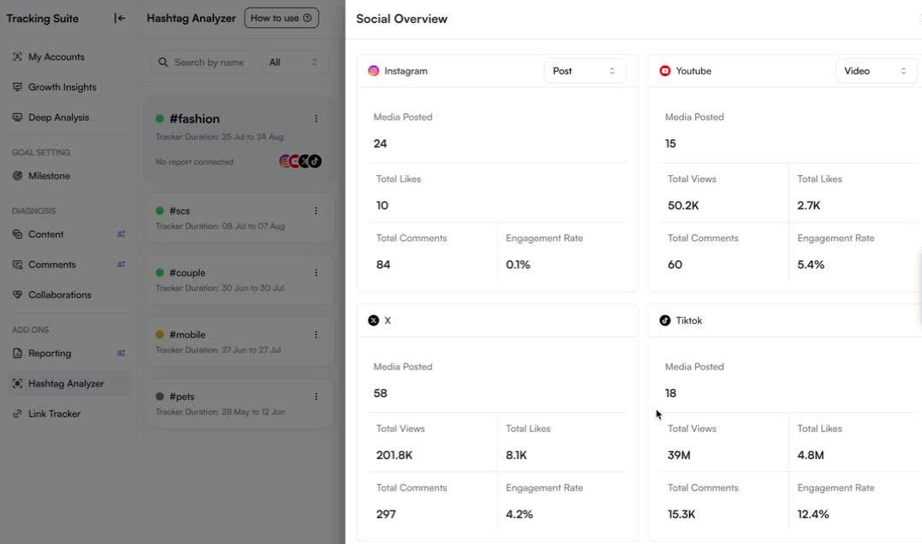
Within the first hour: The dashboard shows comment volume, sentiment breakdown (positive, neutral, negative), and a prioritised list of comments by type. Purchase intent questions flagged. Service issues flagged. Negative sentiment is visible as a percentage of total comments.

When a negative spike appears, the brand manager sees it on the dashboard rather than discovering it during the next manual check. The response occurs while the conversation is still active.
During the campaign: The Competitor Comments Radar in CultureX's Listenings.ai shows how competitor audiences are responding to similar content in the same category. That context answers an important question: Is this negative feedback specific to this campaign, or is it a category-wide sentiment shift that every brand in the space is dealing with?

After the campaign: The AI Brand Strategizer answers strategic questions from the community data: which content type generated the most positive engagement, which posts generated product feedback worth passing to the product team, and which responses generated positive follow-up from the original commenter.
Six signs the current process is not keeping up.
Comments on high-reach posts go unanswered for more than 24 hours because the volume is too high to get through manually.
The brand discovered a customer service issue in an influencer's comment section after it had been running for more than six hours.
The social team cannot tell the marketing team what the most common audience sentiment was in last month's campaign comments without manually reading through them.
Purchase intent signals in comment sections are missed because they are buried under general engagement volume.
There is no structured way to identify which content type generates the most positive community engagement versus the most complaints.
A competitor brand responded to a category-level sentiment shift faster than the brand did because the brand was not monitoring at that level.
The gap between community management done manually and community management supported by AI is not the voice of the brand. The voice stays human. The gap is in speed, classification, and pattern recognition.
A human team can respond thoughtfully to 50 comments a day. AI classification means the right 50 comments get a response, not the first 50 that appeared on screen.
That is what makes community management actually scalable.
Ready to see how CultureX manages brand community engagement at scale? Start your free trial.
FAQs
What is community management?
Community management is the ongoing process of building and protecting a brand's relationship with its audience across social platforms. It covers four functions: response handling, content moderation, engagement nurturing, and sentiment monitoring. Most brands are only running one or two of these consistently, which is why community engagement often feels reactive rather than proactive.
What does a community manager do for a brand?
A community manager is the person who keeps a brand connected with its audience every day. They reply to comments and messages, remove spam or inappropriate content, monitor how people feel about the brand, and jump into conversations when needed. They also spot trends in customer feedback that can help improve future content and campaigns. As the community grows, AI can handle sorting and organising messages, freeing the community manager to focus on conversations that require a real person.
How is AI used in community management?
AI classifies comments by type automatically (product feedback, service issues, purchase intent, brand mentions), monitors hashtag sentiment across platforms in real time, categorises brand content by theme using Smart Labels, and answers strategic questions about community data through conversational tools like CultureX's AI Brand Strategizer. The human still writes every response. AI ensures the right responses occur at the right time.
How do brands manage high comment volumes on social media?
Through AI comment classification that prioritises comments by type rather than by their visibility at the top of the feed. CultureX's Track.social automatically tracks every comment, so the brand team sees a filtered, prioritised view: purchase intent first, service issues second, general engagement last. A 500-comment thread becomes manageable because the 12 purchase intent signals are visible without having to read all 500 comments.
What is the difference between social media management and community management?
Social media management covers publishing content, scheduling posts, and tracking reach and engagement metrics. Community management covers what happens in the comment sections, DMs, and mentions after content goes live. The two overlap but serve different purposes. A brand can have excellent content and still have a community management crisis if the response handling and sentiment monitoring functions are not in place.
How does sentiment analysis help with community management?
It tells the brand whether the overall reaction to a post or campaign is positive, negative, or neutral without requiring a human to read every comment. More importantly, AI comment classification goes beyond sentiment direction to identify what the sentiment is about: a product quality concern, a service complaint, or a competitor comparison. That specificity is what allows the brand to respond to the right issue rather than just knowing that something is wrong.
What tools do brands use for community management at scale?
When a brand manages a large online community, using separate tools for every task becomes difficult. That's why many teams prefer platforms that combine comment tracking, hashtag monitoring, and cross-platform insights in one dashboard. CultureX's Track.social helps organise comments by type, tracks hashtags across Instagram, YouTube, and TikTok in real time, and automatically labels content with AI Smart Labels. Listenings.ai complements this by helping brands understand how competitor audiences are responding to similar content.
How does CultureX support brand community management?
Track.social's AI classifies comments across all connected brand accounts by type, going well beyond positive and negative sentiment. The Hashtag Analyzer monitors campaign hashtags in real time across four platforms simultaneously, flagging negative sentiment spikes as they form. The AI Brand Strategizer answers specific questions about what the community data means for strategy, without requiring manual analysis. And Listenings.ai's Competitor Comments Radar shows how competitor audiences are responding to similar content, giving the brand context when its own sentiment shifts.


Comments