
Free vs Paid Social Listening Tools: Is It Worth Upgrading?
- Sanket Maheshwari
- 8 hours ago
- 8 min read

A brand manager has been using Instagram's native insights and a free mention tracker for the past year. Last week, a competitor launched a new product. Within 48 hours the category conversation had shifted. Her comment sections filled with questions comparing the two products.
The free tool showed that mentions were increased.
It could not show what those mentions were saying, how sentiment was trending, or how the competitor's launch content was performing.
She knew something was happening. She had no idea what it meant or what to do about it.
That is usually when brands start looking at paid social listening platforms.
What free tools actually do well
This is worth being honest about. Free tools are not useless. For certain situations, they are genuinely fine.
Most native platform analytics and free mention trackers cover three things reasonably well.
Tagged mention tracking. Notifications when the brand gets directly tagged or mentioned on the platforms the tool operates on. For low-volume monitoring, this works.
Basic account metrics. Basic account metrics are available through the built-in dashboards on Instagram, YouTube, and TikTok. They show details like follower count, reach, engagement, and audience demographics for your own account. If you only want to track your brand's performance on a single platform, these dashboards are a good place to start.
Single-platform hashtag volume. Some free tools show how many posts used a brand's hashtag and surface recent content. Volume data is there. Sentiment is not.
For a brand that posts occasionally, manages low comment volumes, and is not particularly concerned with competitor activity, free is probably fine.
But after that? The limits are real and they arrive quickly.
Where free tools stop being useful
No cross-platform sentiment analysis.
Free tools show that conversations are happening. They do not show whether those conversations are positive, negative, or neutral. They cannot classify comment types: product feedback, service complaints, purchase intent, and brand comparisons. For a brand managing meaningful comment volume across Instagram, YouTube, and TikTok, manually reading comments to understand sentiment is not scalable. It is just hoping someone notices something important.
No competitor intelligence.
Free tools track what is happening to the brand. They do not track what is happening to competitors. Which creators a competitor is working with, how their audience is responding to new content, which posts are performing best, and whether their community sentiment is shifting. None of this is available in free or native analytics.
For a brand in a competitive category, not tracking competitors is not neutral. It is a blind spot.
Limited historical data.
Native analytics usually provide access to only the past 28 to 90 days, and free tools can be even more restrictive. As a result, it's hard to track year-long trends, seasonal patterns, or understand how content performance has changed over time.
No cross-platform unified view.
A brand active on Instagram, YouTube and TikTok needs four separate dashboards to understand what is happening across all of them. Free tools are typically single-platform or provide only surface data across platforms, not the depth needed for strategy decisions.
No real-time campaign tracking. When a brand runs an influencer campaign, the campaign hashtag needs to be monitored continuously, not in a daily or weekly batch. A free tool that updates once a day cannot tell the brand whether a campaign is building positive momentum or quietly generating complaints while it is still running.
What paid tools actually add.
Comment classification beyond positive and negative
A paid platform does more than count comments. Instead of simply showing that a post received 500 comments, it breaks them down into useful categories like product feedback, service complaints, buying interest, and brand comparisons. This makes it easier to understand what people are actually talking about, instead of just looking at a number.
CultureX's Track.social uses AI to tag every comment by type across all connected brand accounts. A brand manager opens a filtered view that shows only purchase intent signals or only service complaints, rather than manually reading through hundreds of comments.

A perfect fix: instead of discovering a wave of service complaints two days after a campaign post went live, the brand sees a service issue spike forming in the dashboard in real time.
Competitor benchmarking across multiple brands at once
A paid platform doesn't just show your own social performance it also helps you track competitors. You can compare follower growth, engagement, content performance, audience insights, and influencer collaborations, making it easier to understand how your brand stacks up.
CultureX's Listenings.ai Market Benchmark lets brands compare their performance with up to 10 competitors from a single dashboard. Along with metrics like followers, Social Score, engagement rate, average views, and branded collaborations, it also highlights content performance trends and the optimal time to post based on competitor activity and audience engagement. A six-month follower growth comparison helps brands understand where they are gaining momentum and where competitors are pulling ahead, making it easier to refine their social strategy.

The Competitive Watch module goes deeper. A 1-vs-1 comparison with a single competitor covering views, likes, comments, engagement rate, growth trends, hashtag usage, audience demographics, and which influencers the competitor is actively working with right now.

Here's what to look for in a paid platform's competitor intelligence:
Branded content filter: separates paid creator collaborations from organic mentions, so the brand can see what a competitor is spending on versus what is happening naturally
Creator partnership tracking: which creators competitors are working with now, not a snapshot from last month
Comments Radar: sentiment analysis on competitor post comment sections, showing how a competitor's audience is actually responding to their content
Historical data that goes back further than 90 days

With CultureX''s Tracking Suite, the Deep Analysis module fetches 500-2,000 posts for long-term trend analysis, rather than the standard 24-post view. A brand can analyse performance patterns across a full year, understand how engagement has shifted across content types, and identify optimal posting times from a significantly larger dataset.
The AI Brand Strategizer within Deep Analysis takes it further. Ask it a plain-language question, "Why did engagement drop in March?" or "Which content type drives the most positive sentiment comments?", and it returns a data-backed answer without requiring manual analysis.
Real-time campaign hashtag tracking across all platforms
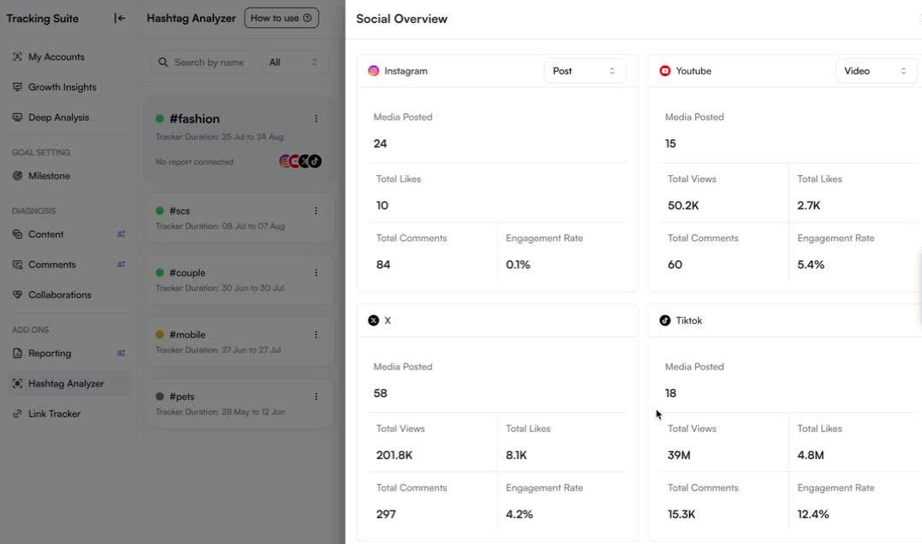
Keeping track of campaign hashtags becomes much easier with CultureX's Hashtag Analyser. It monitors Instagram, YouTube, TikTok, and X together, collecting at least 50 posts from each platform every day. You can organise the results by views, engagement, comments, follower count, or newest posts. The tool also highlights whether the conversation is mostly positive or negative, so any negative spike shows up right away instead of appearing in a report the next day.
See what CultureX's paid social listening covers across competitor benchmarking, sentiment classification, and real-time hashtag tracking. Explore the platform.
When to stay on free, and when to switch
Stay on free if:
Your brand is active on just a couple of social channels with a manageable number of comments.
You're not focusing on competitor tracking right now.
Influencer campaigns are occasional and not part of your regular marketing efforts.
You're mainly interested in tagged mentions and don't need to track untagged discussions in your industry.
Upgrade when:
Comment volume on individual posts outpaces what the team can manually read and classify
A competitor's social activity has become relevant to the brand's own decisions.
Influencer campaigns generate untagged conversations that the brand needs to track.
The brand discovered that sentiment shifts had happened late.
Campaign reporting needs real-time data rather than post-campaign summaries.
Leadership needs more than reach and follower counts to justify the social budget.
The real difference comes down to the questions you're trying to answer. Free tools can tell you what happened. A paid platform helps you understand why it happened and what you should do next. Once those answers become important, investing in a platform makes sense.
Eight things to check before committing to a paid platform
Does it track Instagram, YouTube andTikTok simultaneously, or only one or two platforms?
Does it classify comment types beyond positive and negative, or just assign a sentiment score?
How many competitors can be tracked at once, and does it include visibility into creator partnerships?
How far back can it analyse per account, and how many posts can it process?
Does hashtag tracking update continuously or in daily batches?
Can the platform answer specific strategic questions about the data, or does it just display the data and leave interpretation to the user?
Is everything in one dashboard, or does using it fully require switching between separate tools?
Does it offer competitor benchmarking, allowing you to compare your brand's performance, engagement, share of voice, and content strategy against competitors in one place?
Without these capabilities, the platform functions primarily as a monitoring tool with an improved interface, rather than a solution that provides meaningful social intelligence and actionable insights.
Free tools do not always provide accurate data, whereas paid tools do and take accountability for it as well. For a brand still at low volume on one or two platforms with no immediate need to track competitors, they are a reasonable starting point.
Most brands reading this are past that stage. The moment campaigns start running, competitors start mattering, and comment volumes outpace what the team can read manually, free tools stop answering the questions that actually drive decisions.
Having more data isn't always the answer. What really helps is getting the right information at the right time so your team can actually use it.
If you're ready to see how social listening can work at scale without adding more complexity, start your free trial on CultureX.
FAQs
What is a free social listening tool?
A free social listening tool helps you track basic conversations about your brand without any cost. In most cases, it covers tagged mentions, branded hashtags, and performance data from your own social accounts. It's a good option for basic monitoring, but it doesn't offer more advanced analysis such as competitor intelligence, cross-platform sentiment tracking, or real-time campaign reporting.
What are the best social listening tools in 2026?
The right tool depends on what your business is trying to achieve. If you only need basic mention tracking, free tools can do the job. But if you want to compare competitors, understand audience sentiment across platforms, follow hashtags in real time, or automatically sort comments using AI, platforms like CultureX offers those capabilities in one place.
What can free social listening tools not do?
Most free tools can't tell you how people feel about your brand across platforms, provide detailed competitor analysis, maintain long-term historical records, combine multiple social channels into a single view, or update campaign tracking in real time.
When should a brand upgrade to a paid social listening platform?
Once social conversations become difficult to manage manually, competitor tracking becomes important, influencer campaigns create conversations beyond tagged posts, or business decisions rely on social data, a paid platform becomes much more useful.
What is the difference between social monitoring and social listening?
Social monitoring focuses on direct interactions, such as mentions, comments, and branded hashtags. Social listening looks at the bigger picture by analysing conversations and trends to understand their implications for the brand. Monitoring tells you what happened, while listening helps explain why it happened and what to do next.
How does sentiment analysis work in social listening tools?
Sentiment analysis uses AI to identify whether online conversations are positive, negative, or neutral. More advanced tools also understand the context, such as whether people are discussing product quality, customer service, buying intent, or brand comparisons. CultureX's Track.social automatically groups these conversations so teams can focus on the most important ones first.
What should I look for in a paid social listening platform?
Cross-platform coverage across all four major platforms simultaneously. Sentiment depth beyond positive and negative to classify comment types. Competitor tracking for multiple brands at once, including creator partnership visibility. Historical data access for at least 1 year. Real-time (not daily batch) hashtag tracking. An AI analysis layer that answers specific strategic questions from the data. And all of it is visible in one dashboard rather than spread across separate tools.
How does CultureX work as a paid social listening platform?
Track.social covers brand-level listening: hashtag tracking across Instagram, YouTube and TikTok in real time, AI comment classification by type, Growth Insights for daily performance tracking. Listenings.ai covers the competitive layer: Market Benchmark for multi-competitor comparison, Competitive Watch for 1-vs-1 deep analysis including creator partnerships, Content Radar for category trend spotting, and Comments Radar for sentiment analysis on competitor content.



Comments